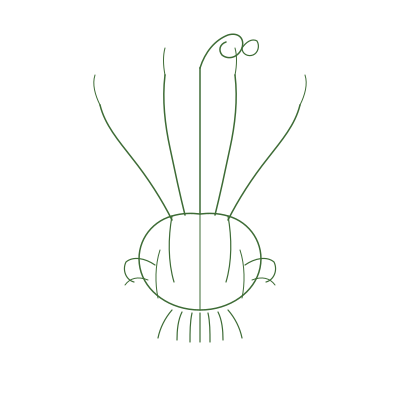
Garlic runs on a different calendar than everyg else in the vegetable garden. You plant it in fall — typically 4 to 6 weeks before your first fall frost, not your last spring frost — and it sits dormant through winter before pushing up green shoots in early spring. That reversed timeline is the thing most first-time garlic growers miss. The directSowWeeksBeforeLastFrost field for garlic is set to -24 to represent a fall planting; the actual timing to aim for is 4 to 6 weeks before your first expected fall frost, so roots can establish before the ground freezes.
The first decision you'll make is hardneck versus softneck. Hardneck varieties — Music, German Extra Hardy, Spanish Roja, Chesnok Red — produce a central woody stalk called a scape in early summer, which curls as it matures. Cut the scape before it straightens and the plant puts more energy into the bulb. Hardnecks tend to have more complex flavor and larger cloves but a shorter storage window, typically four to six months. Softneck types like Inchelium Red don't produce scapes, store up to a year, and are the variety you'll find braided in markets. If you're in a zone 7 or warmer climate, softneck varieties tend to do better — hardnecks need a genuine cold period to form well-separated cloves.
Plant individual cloves with the flat root end down and the pointed tip up, about 2 inches deep, 6 inches apart. the bed with 4 to 6 inches of straw after the ground has started to chill — this insulates roots through winter without preventing the cold exposure the bulbs need. In spring, the mulch can stay in place as the shoots emerge through it, suppressing weeds through the long ahead.
The most common failure mode is basal rot, caused by Fusarium culmorum or related fungi. It shows up as yellowing leaves and a pink-brown discoloration at the base of the cloves, often after a wet, mild winter. Good drainage is the main prevention; planting disease-free seed garlic from a reputable supplier is the second. Don't save and replant cloves from a bed where you've seen rot — the pathogen persists in the soil. Another common mistake is harvesting too late. Once the lower third to half of the leaves have turned brown and died back, the bulbs are ready. Leave them longer and the wrapper sheaths begin to deteriorate, shortening storage life.
Harvest when half the leaves are still green and half have browned — roughly 24 weeks after fall planting, or whenever that window falls in your local calendar. Lift with a fork rather than pulling by the stem, which can bruise the neck and invite mold during curing. Cure in a dry, shaded spot with good airflow for three to four weeks before trimming and storing. Hardnecks can bruise and begin to dehydrate faster than softnecks, so use those first. The cloves from your best bulbs can go back in the ground next fall — garlic rewards the grower who pays attention to which plants performed best.
Varieties worth knowing
Growth habit — pick before you buy seed
The same crop can grow as a compact bush, a sprawling vine, or something in between. Choose the habit that fits your space and how you want the harvest to arrive — all at once, or a steady trickle.
Forms a single bulb of cloves after winter vernalization. Hardneck types also send up an edible scape.
What can go wrong
Companions
How to propagate
Garlic is propagated by planting individual cloves, not from true seed. Fall planting is strongly preferred, as garlic needs a cold period to develop proper bulbs, and spring-planted garlic produces notably smaller heads.
Harvest & keep
Plant cloves in fall (6 weeks before ground freezes); harvest 9 months later when lower leaves brown.
- Refrigerator
- do not refrigerate cured bulbs — they'll sprout
- Freeze
- peel cloves, freeze whole or chopped in oil cubes
- Can
- not recommended — botulism risk in garlic-in-oil preparations without acidification
- Dry
- dehydrate slices at 125°F, grind into powder
- Cure
- Cure whole plants with tops on for 2–3 weeks in a warm, dry, airy spot; then trim roots and tops.
Hardneck types keep 4–6 months; softneck up to 9–12 months at 55–65°F, 50–60% humidity. Never store garlic in oil at room temperature.
How it grows where you live
Sources
- Growing Garlic in the Home Garden— Penn State Extension
- Garlic Production for the Gardener— University of Minnesota Extension
- Garlic: Organic Production— NCAT ATTRA Sustainable Agriculture
Save seed from this plant
Garlic is propagated by clove, not seed. One bulb saved = roughly 8 new plants.