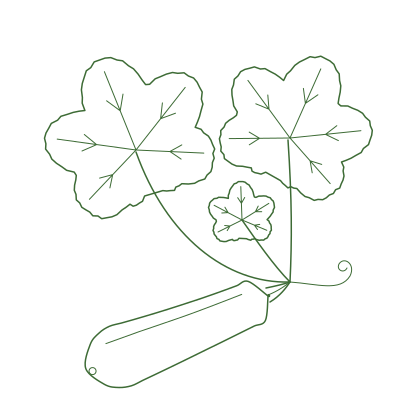
Korean Zucchini (Aehobak)
Cucurbita moschata
A vining summer squash picked small and tender — kin to butternut, not to Italian zucchini.
When to plant: start seeds indoors about 3 weeks before your last frost.
Updated Oct 2026
At a glance
| Sun | Full sun |
|---|---|
| Water | Moderate |
| Spacing | 36 inches |
| Days to maturity | 55–70 days |
| Soil pH | 6.0–7.5 |
| Soil | Rich, well-drained soil with plenty of compost worked in. Raised hills warm faster in spring. |
| Hardiness zones (USDA) | 3–11 |
| Difficulty | Beginner |
| Family | Cucurbitaceae |
| Native range | Tropical Central and northern South America (Cucurbita moschata); aehobak types were selected in Korea |
Tip for beginners: Put up a 5-foot trellis before you plant, transplant 1 week after your last frost into warm soil, and check for fruit every day or two once flowering starts
Main challenge: The vines need a trellis or a lot of ground, and the fruit has to be picked within a few days of reaching 5–6 inches; powdery mildew usually slows the plants in late summer
When to plant
- Start seeds indoors 3 weeks before your last frost.
- Transplant outdoors 1 week after your last frost.
- First harvest about 8 weeks after transplanting.
What can go wrong
- Powdery mildew. White, powdery patches on the older leaves in late summer, spreading until the leaves yellow and production drs. Trellising, good spacing and watering at the base slow it down; keep picking until frost.
- Squash vine borer. Less common on aehobak than on zucchini, but still possible. Look for sawdust-like frass at the stem base and a section of vine that wilts in the afternoon. Bury a few nodes along the vine so it has backup roots.
- Fruit grows too big and hard. Aehobak passes its best size wi days. Fruit left on the vine develops a hard rind and slows new fruit set. Check every day or two and pick at 5–6 inches.
- Small fruit that shrivels. Young female flowers that turn yellow and drop. Usually poor pollination early in the season, when male flowers outnumber female ones or bees are scarce. Hand-pollinate with a small brush in the morning.
- Squash bugs. Gray-brown, flat-backed bugs and clusters of bronze eggs on the undersides of leaves. Check leaves every few days, crush the egg clusters, and knock adults into soapy water.
Growing guide
Aehobak and zucchini get swapped for each other in recipes, but in the garden they are different plants. Italian zucchini is Cucurbita pepo, usually grown as a compact bush. Korean aehobak is Cucurbita moschata, the same species as butternut squash, and most varieties sold in the US grow as long vines. The fruit is pale to glossy green, club- or avocado-shaped, and picked small, often about a week after the flower opens. Plant it where you would put a zucchini and you may find it climbing the fence by midsummer.
It wants the same warmth zucchini does. Start seeds indoors 3 weeks before your in individual pots, since squash roots resent disturbance, and 1 week after your last frost once the soil is at least 60°F. You can also sow directly, 1 inch deep with two seeds per spot, once the soil has warmed. Give each plant about 3 feet along a trellis, or 3 to 4 feet between hills if it sprawls. A sturdy trellis or cattle panel about 5 feet tall keeps fruit clean and straight and makes it far harder to miss one under the leaves.
On a trellis, the vines need tying every few days at first; once the tendrils catch, they mostly climb on their own. Water deeply at the base and , because uneven moisture tends to give misshapen fruit. Early in the season the plant often makes only male flowers, and the first female flowers, the ones with a tiny squash behind them, may drop without setting. That usually settles within a couple of weeks. Bees do the pollinating; if they are scarce, moving pollen from a male flower to a female one with a small brush in the morning can help.
The species difference matters most with squash vine borer. Extension research ranks C. moschata as the least susceptible squash species: the moths lay fewer eggs on it and the larvae have a harder time getting established in the stems. It is not immune, so still check the base of the vine for sawdust-like frass and sudden wilting. Vining plants also root where a leaf node touches soil, and burying a few nodes along the vine gives the plant backup roots if one section is attacked. Powdery mildew tends to be the bigger problem: white, flour-like patches that start on older leaves in late summer and spread until production slows. Squash bugs and cucumber beetles feed on aehobak as they do on any squash.
Pick when the fruit is about 5 to 6 inches long and the skin is still glossy and thin. Check every day or two in peak season. A fruit left on the vine keeps growing into a mature squash with a hard rind and full-sized seeds, and the plant tends to set fewer new fruit while it carries one. In Korea, growers often slip young fruit into plastic sleeves so they grow straight and uniform for market; that is optional at home, and a trellis does much of the same work. Most aehobak sold in the US is an , and it crosses with butternut, so saved seed is unlikely to grow true.
Harvest and keep
Expected yield
| Per plant | 6–10 lb over the season |
|---|---|
| Per square foot | 1–2 lb at 36-inch spacing; more when trellised |
| Peak harvest lasts | 8 weeks |
Steady picking at 5–6 inches keeps the vine setting fruit. Two plants are usually enough for a household that cooks Korean food often.
Keeping the harvest
| Refrigerator | 5–7 days (unwashed, in a bag) |
|---|---|
| Freeze | slice or cut into half-moons, blanch 3 minutes, cool, and freeze for soups and stews |
| Can | not recommended as plain squash — no tested home-canning process exists for summer squash; freeze or dry instead, or water-bath only a tested pickle or relish recipe |
| Dry | slice thin and dry at 125°F (hobak-goji, used rehydrated in namul) |
Fruit that grows past picking size can be left to mature into a hard-rinded squash and cooked like winter squash.
Varieties worth knowing (3)
- Teot Bat Put · 65–70 days. Korean hybrid sold untreated by Kitazawa. Avocado-shaped, glossy green fruit with pale yellow flesh; trains well on a trellis.
- Early Bulam · 65–70 days. Vigorous vining hybrid with thin, light green skin and oval fruit about 5–6 inches long. Kitazawa notes the seed is treated with thiram; choose Teot Bat Put if you want untreated seed.
- King Ka Ae · 55–70 days. Semi-bush hybrid with smooth, shiny skin and dense flesh, sold for hobak-jeon. Pick at 5–6 inches. A better fit than the long vines where trellis space is short.
Growth habit (2)
The same crop can grow as a compact bush, a sprawling vine, or something in between. Pick the habit before you buy seed: it decides how much space the plant takes and whether the harvest comes all at once or over many weeks.
Vining
Most aehobak varieties send out long vines with tendrils. Trained up a trellis they take little ground and the fruit hangs clean and straight.
Pruning and support: Tie the main vine to the trellis every few days until the tendrils hold. Bury a few nodes of any vine left on the ground so it roots.
Examples: Teot Bat Put, Early Bulam
Semi-bush
Shorter-vined types that stay more compact. They can sprawl on the ground or be tied to a short support.
Examples: King Ka Ae
Companions (6)
Grows well with
Companion pairings are mostly traditional. Research support for most of them is limited.
How to propagate (1)
Aehobak grows fast from seed, either sown directly once the soil is warm or started indoors a few weeks ahead in individual pots.
From seed · easy · 90%+ success rate
When: Start indoors 3 weeks before the last frost; transplant or direct sow 1 week after it, once soil is at least 60°F
Sow seeds 1 inch deep, two per pot or per spot, and thin to the strongest seedling. usually takes 5–10 days in warm soil. Transplant without disturbing the roots, about 3 feet apart along a trellis or 3–4 feet apart in hills. Set the trellis before planting.
Regional notes (6)
Pacific Northwest
West of the Cascades, wait for the soil to warm before transplanting; a black plastic mulch or a for the first weeks helps. Powdery mildew tends to arrive early in the damp air, so a trellis that lifts the vine into moving air is worth the effort. Vine borers are uncommon here.
Mountain West
At elevation, cold nights slow the plants, so use a row cover early and choose a warm, sheltered spot. Most aehobak varieties need about 55–70 days from transplant, so in the shortest seasons choose the earlier, more compact King Ka Ae. Vine borers are rare here; powdery mildew is the usual late-season problem.
Southwest
In the low desert, plant in spring to harvest before peak heat, and again in late summer for a fall crop. Temperatures above about 95°F often stop fruit set. Shade cloth in the afternoon and deep drip irrigation help the vines through the hottest stretch.
Midwest
Grows well in Midwest summers once the soil is warm. Vine borers are common, and burying a few nodes on each vine gives backup roots if the base is attacked. Sturdy trellis anchors matter; summer storms can flatten a loaded vine.
Northeast
Summers are long enough for a steady harvest. Squash vine borer is common in much of the region, which makes aehobak a good swap for gardeners who lose zucchini to it every year. Still check stem bases in early summer, and expect powdery mildew late in the season.
Southeast
The long, hot season suits aehobak and allows a spring planting and a second planting in midsummer for fall harvest. Squash bugs, cucumber beetles and powdery mildew are the main pressures; a trellis, wide spacing and early checks for egg clusters help.
Saving seed
Saving seed
- Difficulty
- Hard. Needs isolation, hand-pollination, or a second year of growth. Reserve for gardeners who want to commit.
- Isolation distance
- 800 ft. Without isolation or hand-pollination, it can cross with nearby varieties.
- Method
- Let a fruit mature fully on the vine, scoop the seeds, rinse, and dry.
- Timing
- When the fruit has a hard rind and the vine has died back, about 6–8 weeks after pollination.
- Drying and storage
- Dry 3 weeks on screens, envelope.
- Viable for
- 6 years (when kept dry and cool)
Most aehobak sold in the US is F1 hybrid and does not come true. C. moschata crosses with butternut and other moschata squash; it does not usually cross with zucchini or acorn squash (C. pepo).
Sources (3)
- Squash vine borer (Melittia cucurbitae) in home gardens, UConn Extension
- Managing squash vine borer in the garden, University of Illinois Extension
- Squash Seeds - Korean, Summer - Teot Bat Put - Hybrid (growing notes), True Leaf Market (Kitazawa Seed)
- AphidSoft, clustered insects on new growth causing curled leaves and sticky honeydew.
- Bacterial WiltCucurbit vines wilt rapidly despite moisture; cut stem shows sticky ooze that threads when pulled apart.
- Blossom End RotDark, sunken, leathery patch on the blossom end of tomato or pepper fruit. The developing fruit is short of calcium, usually because of uneven watering rather than a lack of calcium in the soil.
- Cucumber BeetleYellow-green beetles chewing cucurbit leaves and flowers; rapid wilting may signal bacterial wilt transmission.
- CutwormTransplants severed at the soil line overnight; fat gray caterpillars curl in the soil beneath.
Related plants: Acorn Squash, Amaranth, Artichoke, Arugula