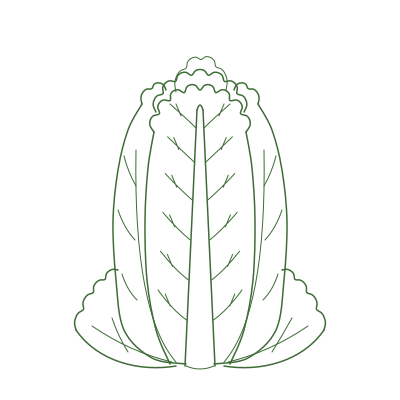
Napa Cabbage
Brassica rapa subsp. pekinensis
The kimchi cabbage — a fast, hungry fall crop that bolts if spring sends it the wrong signals.
When to plant: sow about 11 weeks before your first fall frost.
Updated Oct 2026
At a glance
| Sun | Full sun |
|---|---|
| Water | High |
| Spacing | 15 inches |
| Days to maturity | 60–80 days |
| Soil pH | 6.0–7.5 |
| Soil | Fertile, well-drained soil with plenty of compost. Napa grows a large head in about two months, so it needs steady moisture and nitrogen; acidic soil raises the risk of clubroot. |
| Hardiness zones (USDA) | 3–11 |
| Difficulty | Some experience |
| Family | Brassicaceae |
| Native range | China (developed in cultivation; no wild form) |
Tip for beginners: Grow it as a fall crop only in your first year, sow on the 11-week date, and put row cover over the bed the same day — most first-year failures come from spring planting or from flea beetles on unprotected seedlings
Main challenge: Timing: sown too early it meets summer heat, sown too late it runs out of season before heading, and spring plantings often bolt after cold nights
When to plant
- Sow, 11 weeks before your first fall frost.
What can go wrong
- Bolting instead of heading. A flower stalk pushes up through the center before a firm head forms. Young plants exposed to a week or more of nights below 50°F, or to frost, can be triggered to later; long, warm days push it further. This is why spring crs fail often and fall crops usually do not.
- Tipburn. Brown, dry edges on the inner leaves, often found only when the head is cut. Caused by poor calcium movement into fast-growing leaves during uneven watering or heat. Keep soil evenly moist and avoid heavy nitrogen late in heading.
- Clubroot. Plants wilt in the afternoon, look stunted and yellow, and have swollen, club-shaped roots. A soilborne disease favored by acidic, wet soil that persists for many years. Rotate brassicas, lime toward 7.2 in affected beds, and grow resistant varieties.
- Flea beetle damage on seedlings. Small round holes across young leaves in late summer. Heavy feeding can stall or kill seedlings. Cover the bed with from sowing or .
- Cabbage worms and loopers in the head. Green caterpillars chew ragged holes and leave dark droppings between leaves, deep inside the head. Row cover prevents egg-laying; Bt sprays work on young caterpillars before they move inside.
- Slugs and soft rot in wet fall weather. Slugs hide in the lower leaves and their feeding opens the way for bacterial soft rot, which turns the base slimy and foul-smelling. Remove damaged outer leaves, keep the bed free of debris, and harvest before long cold, wet spells.
Growing guide
In Korea, cabbage for kimjang kimchi is sown as summer winds down and cut as the nights turn cold, and that calendar carries over well to most US gardens. Napa cabbage has a narrow comfort range. It grows best with days in the 60s °F, it tends to bolt if young plants sit through a week or more of nights below 50°F, and it tends to bolt or rot in summer heat. A spring crop has to dodge both problems at once. A fall crop starts warm and finishes cool, the order the plant prefers, which is why napa is mainly a fall vegetable in the US.
Sow about 11 weeks before your first fall frost. You can three or four seeds every 12 to 18 inches and to one plant, or start seeds in cell trays and set them out three to four weeks later. Napa sulks after root disturbance, so move transplants with the root ball intact and water them in. Give round, barrel-shaped heads about 18 inches; tall Michihli types and minis can go at 12. Full sun suits the fall crop, but in hot regions late-summer seedlings may need shade cloth for their first week or two.
Napa is fast and hungry. It can build a head of several pounds in about two months, so steady water and nitrogen matter more than with most brassicas. Aim for about an inch of water a week, more during hot spells, and with nitrogen three to four weeks after transplanting or thinning. Uneven watering shows up as tipburn: brown, papery edges on the inner leaves that you often find only after cutting the head open. Tipburn is a calcium shortage inside the leaf, usually caused by fast growth during uneven moisture rather than a lack of calcium in the soil, so steady watering prevents more of it than extra lime does.
Pests arrive early. Flea beetles can riddle late-summer seedlings with small holes, and cabbage worms and loopers feed their way into the head, where they are hard to wash out before making kimchi. Row cover laid over the bed on the day you sow or transplant, and left on until the weather cools, keeps out most of both. Clubroot is the disease to worry about in acidic soil. Plants wilt on warm afternoons, recover overnight, and show swollen, knotted roots when pulled. Its spores can survive in soil for many years, so rotate all cabbage-family crops, raise the pH toward 7.2 in beds where it has appeared, and look for resistant varieties such as Bilko. If you try a spring crop, choose a slow-bolting variety, keep seedlings warm indoors, and plant out only once nights stay above 50°F; it often bolts anyway.
Harvest when the head feels firm when you squeeze it from top to bottom, and cut it at the base with a knife. Mature heads usually handle a light frost, but a hard freeze in the low 20s can damage the outer leaves and lead to rot, so cut before such a forecast. For kimchi, heads that have been through a few cool nights tend to be sweeter. Trimmed heads wrapped in newspaper can keep one to two months near 32°F with high humidity, which is longer than most people expect from such a tender-looking vegetable.
Harvest and keep
Expected yield
| Per plant | 1 head (1–2 lb for mini types; 3–6 lb for full-size) |
|---|---|
| Per square foot | 1.5–3 lb |
| Peak harvest lasts | 2 weeks |
Mature heads hold in the garden for a week or two in cool fall weather; in warm weather they can split, rot, or bolt soon after reaching size.
Keeping the harvest
| Refrigerator | 2–4 weeks (whole head in a bag) |
|---|---|
| Freeze | not recommended raw; shredded leaves can be blanched 1 1/2 minutes and frozen for cooked dishes |
| Can | not recommended — make kimchi and keep it refrigerated |
| Dry | not recommended |
| Root cellar | trimmed heads wrapped in newspaper keep 1–2 months near 32°F with high humidity |
For kimchi, salt heads within a few days of harvest while the leaves are crisp.
Varieties worth knowing (4)
- Bilko · 57 days. Full-size napa with dark green, roughly 12-inch heads and a mild, sweet flavor. Slow to bolt and widely adapted. A good first choice where clubroot has been a problem.Disease resistance: clubroot, fusarium yellows
- Haku · 55 days. Full-size hybrid with heavy heads averaging 5 1/2 to 6 lb. Listed by Johnny's as its most heat-tolerant and tipburn-tolerant napa, which makes it useful where late summer stays hot at sowing time.Disease resistance: clubroot (intermediate), downy mildew (intermediate)
- Minuet · 48 days. Mini napa hybrid with 9-inch heads, dark green outside and yellow inside. Slow to bolt and suited to small beds at 12-inch spacing. A manageable size for a household batch of kimchi.Disease resistance: downy mildew
- Michihli · 70–75 days. Open-pollinated, tall cylindrical type rather than a round napa head. Upright and somewhat looser, with a longer time to maturity. Widely sold and suited to closer spacing.
Growth habit (2)
The same crop can grow as a compact bush, a sprawling vine, or something in between. Pick the habit before you buy seed: it decides how much space the plant takes and whether the harvest comes all at once or over many weeks.
Napa (barrel-headed)
Forms a dense, barrel-shaped head of crinkled leaves with pale yellow centers. Needs 15–18 inches between plants to head fully.
Pruning and support: No pruning. Remove damaged outer leaves and harvest the whole head when firm.
Examples: Bilko, Haku, Minuet
Michihli (tall-headed)
Forms a tall, narrow, cylindrical head. Can be spaced closer, about 12 inches.
Pruning and support: No pruning. Some growers loosely tie the outer leaves to firm up the head.
Examples: Michihli
Companions (5)
How to propagate (1)
Napa cabbage is grown from seed, either direct sown or started in cell trays. It dislikes root disturbance, so transplants should be young and moved with the root ball intact.
From seed · moderate · 80–90% success rate
When: For the main fall crop, sow about 11 weeks before your first fall frost, directly or in cells to transplant 3–4 weeks later
Sow seeds 1/4 inch deep, 2 seeds per cell or 3–4 seeds every 12–18 inches in the bed, and thin to one plant. is fast in warm soil. Transplant at 3–5 weeks without disturbing the roots and water in well. For a spring trial, keep seedlings at 60–70°F and plant out only once nights stay above 50°F to reduce bolting.
Regional notes (6)
Pacific Northwest
West of the Cascades, mild falls give napa a long, slow heading period and good quality. Wet weather late in the season brings slugs and soft rot, so keep beds clean and harvest before extended cold rain. East of the mountains, late-summer heat at sowing calls for shade cloth and daily watering.
Mountain West
Cold nights at elevation make spring plantings especially likely to bolt, so treat napa as a fall crop. Low humidity and wind speed up water loss and tipburn; water deeply and evenly. Row cover adds a few degrees of protection against early freezes.
Southwest
In the low desert, grow napa as a , sowing once daytime highs drop below about 90°F and harvesting through winter. Haku is noted for good performance in Arizona and California. At higher elevations, follow mountain-west timing.
Midwest
Sow on schedule — the fall season is short and an early hard freeze can arrive soon after the . Choose a variety around 55 days such as Haku or Bilko and keep seedlings well watered through late-summer heat.
Northeast
A reliable fall crop. Seedlings coincide with peak flea beetle season, so start under row cover or raise transplants indoors. Many soils in the region are naturally acidic; test pH and lime before planting, since clubroot is a common problem in older vegetable beds.
Southeast
Grown from late summer into winter. Late-summer heat is the main obstacle: if daytime highs are still above about 90°F on your sowing date, sow a week or two later, since mature heads hold well through light frosts. Haku is listed for heat and tipburn tolerance. In mild coastal areas, harvest can run into winter.
Saving seed
Saving seed
- Difficulty
- Hard. Needs isolation, hand-pollination, or a second year of growth. Reserve for gardeners who want to commit.
- Isolation distance
- 2640 ft. Without isolation or hand-pollination, it can cross with nearby varieties.
- Method
- Insect-pollinated and crosses with other Brassica rapa crops such as bok choy, turnip, and mizuna. Needs a winter chill to flower, so heads are overwintered in mild areas or stored and replanted in spring.
- Timing
- Harvest pods when they turn tan in late spring or early summer of the second season.
- Drying and storage
- Dry pods fully, thresh, screen, and store seed cool and dry.
- Viable for
- 4 years (when kept dry and cool)
Most popular napa varieties are hybrids and do not come true from saved seed; save only from open-pollinated types such as Michihli.
Sources (3)
- Growing Chinese cabbage and bok choy in home gardens, University of Minnesota Extension
- Cabbage & Chinese Cabbage, Clemson Cooperative Extension Home & Garden Information Center
- Chinese (Including Napa) Cabbage Key Growing Information, Johnny's Selected Seeds
- Black RotV-shaped yellow lesions at brassica leaf margins with blackened veins inside — a bacterial disease that moves through the vascular system.
- Cabbage LooperRagged holes in brassica leaves made by a pale green caterpillar that loops its body as it moves.
- Cabbage MaggotBrassica transplants wilting and dying as white maggots tunnel through roots at or below the soil line.
- Imported CabbagewormRagged holes in brassica leaves with pale green caterpillars and green frass nearby.
- ClubrootBrassica plants wilt and yellow despite watering; roots show club-shaped swellings when dug.
Related plants: Acorn Squash, Sweet Alyssum, Amaranth, Artichoke