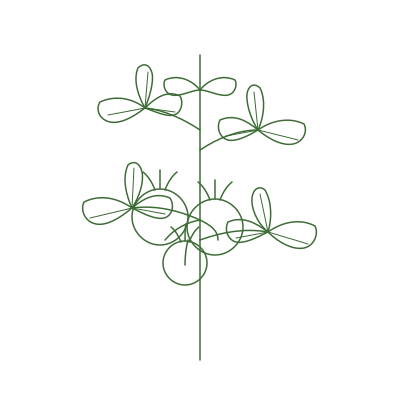
A tomato is a trical plant pretending to be a garden vegetable. It came out of the Andes, and its instincts still live there — warm nights, long days, soil that stays above fifty degrees. Most of what goes wrong with tomatoes in a home garden is a version of the same story: the gardener was too eager, the soil was too cold, and the plant never quite recovered.
The most useful g you can do in spring is wait. A tomato into sixty-degree soil will sit and sulk for three weeks; a tomato transplanted into seventy-degree soil will catch up and pass it. Check the soil with a thermometer, or push your hand in — if it feels cold to you, it feels cold to the plant. Two weeks after your is usually a safer bet than the itself.
When you do transplant, bury the stem deep — up to the first real set of leaves. Tomatoes grow roots along any buried stem, and a deeper root system means a plant that is harder to knock over in a summer storm and less prone to wilting in a dry week. Pinch off the lower leaves before you bury them.
matters more than most new gardeners think. A two- to three-inch layer of straw or shredded leaves keeps the soil evenly moist and, more importantly, keeps soil from splashing up onto the lower leaves when it rains. Splashed soil is how early blight gets started, and early blight is how most home-garden tomatoes die in August.
Water deeply and on a schedule. Uneven watering is what causes — that black, leathery patch on the bottom of the first ripe fruit — and it is almost never a calcium deficiency in the soil, despite what the internet will tell you. The calcium is there. The plant just couldn't pull it up because the soil went from dry to drenched and back again.
In the fall, when the is coming, pick every tomato that has started to blush. They will ripen on a windowsill just as well as they would on the vine, and you'll lose none of them to a cold night. A green tomato that is completely green will not ripen indoors — those, or fry them.
Varieties worth knowing
Growth habit — pick before you buy seed
The same crop can grow as a compact bush, a sprawling vine, or something in between. Choose the habit that fits your space and how you want the harvest to arrive — all at once, or a steady trickle.
Stops growing at a fixed size and sets fruit in a concentrated wave over 2–3 weeks. Good for canning, small spaces, and short seasons. Fruit ripens roughly at once.
Pruning & support: Do not prune the main stem. Minimal suckering — aggressive pruning reduces yield.
Keeps growing and setting fruit until frost. Larger plants, staggered harvest from midsummer through fall. Most heirlooms are indeterminate.
Pruning & support: Prune suckers in the lower axils to keep a single or double leader. Cage or stake — plants can reach 6–8 feet. Top the main stem about 30 days before first frost so energy goes to ripening.
Grows larger than a true determinate but stops earlier than an indeterminate. Fruit over a longer window but not until frost.
Pruning & support: Light pruning of lower suckers; cage or stake but no aggressive training.
What can go wrong
- Iron Lady — Early blight + late blight + Septoria stack · Determinate — built for humid-summer disease pressure.(vs Early Blight)
- Mountain Merit — EB, LB, Verticillium, Fusarium · Determinate slicer.(vs Early Blight)
- Defiant PhR — EB, LB, V, F · Widely available determinate.(vs Early Blight)
- Juliet — Early blight tolerance · Roma-type cherry — reliable producer.(vs Early Blight)
- Celebrity — F1–F2 Fusarium, V, N, T · Three-letter VFN is the baseline look-for on any tomato seed packet.(vs Fusarium Wilt)
- Big Beef — F1–F2, V, N, T, A, St · Stacked resistance, widely available.(vs Fusarium Wilt)
- Mountain Fresh Plus — F1–F3, V · Determinate.(vs Fusarium Wilt)
- Mountain Merit — F1–F3, V, EB, LB · Resistant across most common tomato diseases.(vs Fusarium Wilt)
- Iron Lady — Ph-2/Ph-3 late blight, early blight, Septoria · Determinate — one of the strongest stacks for humid-summer gardens.(vs Late Blight)
- Mountain Magic — Ph-2/Ph-3 late blight, Verticillium, Fusarium · Cocktail/campari-style indeterminate.(vs Late Blight)
- Defiant PhR — Ph-2/Ph-3 late blight, Verticillium, Fusarium · Slicer, determinate — easy to find.(vs Late Blight)
- Plum Regal — Late blight, early blight · Paste tomato, good for sauce gardens.(vs Late Blight)
- Jasper — Ph-2/Ph-3 late blight · Cherry — All-America Selections winner.(vs Late Blight)
- Celebrity — V, F1–F2, N, T · VFN baseline — look for 'N' on any tomato seed packet in nematode country.(vs Root-Knot Nematode)
- Big Beef — V, F1–F2, N, T, A, St · Indeterminate with full disease stack including nematode.(vs Root-Knot Nematode)
- Better Boy — V, F, N · Classic VFN hybrid.(vs Root-Knot Nematode)
- Celebrity — V, F1–F2, N, T · Classic VFN determinate. Look for 'VFNT' on the tag.(vs Verticillium Wilt)
- Better Boy — V, F, N · Indeterminate VFN.(vs Verticillium Wilt)
- Big Beef — V, F1–F2, N, T, A, St · All-America Selections, widely available.(vs Verticillium Wilt)
- Defiant PhR — V, F, LB, EB · Disease-stack determinate.(vs Verticillium Wilt)
Companions
How to propagate
Tomatoes are most commonly started from seed indoors, but they can also be propagated by rooting stem cuttings from suckers, which is a quick way to clone a favorite plant or extend the growing season.
Harvest & keep
Yield drops sharply when daytime highs stay above 90°F — pollen becomes sterile and fruit set stalls until nights cool. A single healthy indeterminate can yield all summer in a mild climate.
- Refrigerator
- Do not refrigerate ripe fruit — chill damages flavor. Fully ripe: 3–5 days at 55–65°F on the counter. Green/breaker tomatoes: up to 3 weeks at 55°F to ripen.
- Freeze
- Whole tomatoes freeze well: wash, dry, freeze on a tray, bag. Skins slip off under warm water. Best for soups and sauces, not fresh.
- Can
- Water-bath can whole or sauce with added lemon juice or citric acid (acidity insurance). Pressure can for safest storage of low-acid varieties.
- Dry
- Slice and dry at 135°F for 8–12 hours, or halve and slow-roast at 200°F until leathery. Store in olive oil in the fridge, or sealed in a cool pantry.
Green tomatoes at frost: ripen indoors in a paper bag with an apple (ethylene speeds it along) or fry green. Never eat tomato leaves or stems — they contain solanine.
How it grows where you live
Sources
- Growing tomatoes in home gardens— University of Minnesota Extension
- Tomato— Clemson Cooperative Extension HGIC
- Tomatoes in the home garden— Colorado State University Extension
- AnthracnoseSunken, dark circular lesions on ripening fruit, sometimes with salmon-colored spores in the center.
- AphidSoft, clustered insects on new growth causing curled leaves and sticky honeydew.
- Blossom DropFlowers fall before setting fruit, often during temperature extremes or after weather stress.
- Blossom End RotDark, sunken, leathery patch on the blossom end of tomato or pepper fruit — a calcium deficiency disorder.
- Gray Mold (Botrytis)Gray-brown fuzzy mold on fruit, flowers, or stems — soft, collapsing tissue beneath the coating in cool, wet conditions.
- I have aphids on multiple plants — do I need to spray everything?Aphids tend to colonize plants under stress and naturally crash when beneficial insects find them — water sprays and patience are often more effective than pesticides.
- What are the black spots on my tomato leaves?Black or dark-brown spots on tomato leaves are usually early blight or Septoria leaf spot — two common fungal diseases with different spot patterns that are managed the same way.
- What is that black leathery patch on the bottom of my tomatoes?Blossom end rot is a calcium deficiency at the fruit level, almost always caused by irregular watering rather than a lack of calcium in the soil.
- Why are my tomatoes cracking and splitting?Tomato skin cracks when the fruit expands rapidly after a period of drought — inconsistent watering is almost always the cause, though some varieties are simply crack-prone.
- Why are my tomato leaves curling?Tomato leaf curl has three main causes — heat stress, herbicide drift, or a virus — and the curl pattern and which leaves are affected help narrow down which one you're dealing with.
Save seed from this plant
Heirloom varieties save true; hybrids (F1) will not. Fermentation kills seed-borne pathogens.