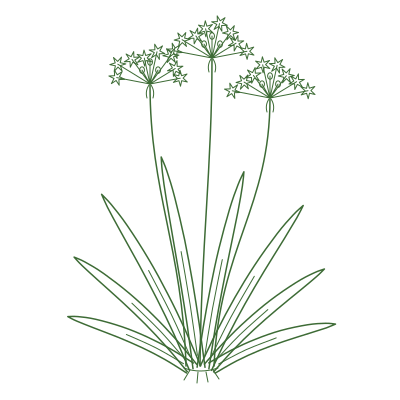
Garlic Chives (Buchu)
Allium tuberosum
Flat, garlic-flavored leaves you can cut to the ground several times a season — and white late-summer flowers that seed freely.
When to plant: start seeds indoors about 8 weeks before your last frost.
Updated Oct 2026
At a glance
| Sun | Full sun |
|---|---|
| Water | Moderate |
| Spacing | 8 inches |
| Days to maturity | perennial — 80–90 (first light harvest from seed) |
| Soil pH | 6.0–7.5 |
| Soil | Well-drained, moderately fertile soil with organic matter. Tolerates heat, cold and dry spells once established, but bulbs can rot in soil that stays waterlogged. |
| Hardiness zones (USDA) | 3–9 |
| Difficulty | Beginner |
| Family | Amaryllidaceae |
| Native range | East Asia |
Tip for beginners: Start from a division or nursery pot instead of seed to save a year, cut the whole clump at once rather than picking leaves, and cut every flower stalk as soon as the blooms fade
Main challenge: Stopping seed set: the white late-summer flowers produce heavy seed, and seedlings that are not pulled young form bulbs and spread through beds and lawn
When to plant
- Start seeds indoors 8 weeks before your last frost.
- Direct sow outdoors around your last frost date.
- Transplant outdoors around your last frost date.
- First harvest about 6 weeks after transplanting.
What can go wrong
- Seedlings all over the garden. Late-summer flowers set seed heavily, and seedlings appear the next spring in beds, paths and lawn. Cut flower stalks as blooms fade, or harvest them in bud. Pull seedlings while young, before they form bulbs.
- Thin, weak regrowth. Usually an old, crowded clump, low fertility, or cutting too often in the first year. Divide clumps every three years or so, after each cutting, and take only light harvests from new plantings.
- Silvery streaks on leaves. Thrips feeding, most common in hot, dry weather. A hard spray of water and steady watering reduce pulations; cutting the clump back removes damaged leaves and the regrowth is often clean.
- Orange pustules on leaves. Rust, which affects many alliums in humid weather. Cut and remove infected leaves, crowded clumps for airflow, and avoid overhead watering.
- Bulbs rotting at the base. Soil that stays waterlogged, especially over winter. Plant in well-drained soil or a raised bed and avoid low spots where water collects.
Growing guide
Garlic chives look like a clump of grass until you brush against them and smell garlic. In Korean cooking they are buchu, the green in buchu-jeon, buchu kimchi and the stuffing for oi-sobagi, and a settled clump can be cut four or five times a season for years. They are among the least demanding in a vegetable garden. That same toughness is why they can turn into a nuisance: the white flowers that open in late summer become a lot of seed.
They are a different plant from common chives, although the two share some care. Common chives (Allium schoenoprasum) have thin, hollow, round leaves, a mild onion flavor and purple flowers in late spring. Garlic chives (Allium tuberosum) have flat, solid leaves about a quarter inch wide, a garlic flavor, and white, star-shaped flowers in late summer on stalks that can reach 2 to 3 feet. Garlic chives also handle summer heat better; common chives tend to sulk in hot weather. In the kitchen they do not substitute well for each other, and buchu dishes made with common chives taste noticeably different.
Start seed indoors about 8 weeks before your , sowing a pinch of seeds per cell, and set the small clumps out around your last frost; seedlings tolerate a light frost. You can also around your last frost, though in cool soil is slow, often two to three weeks. Plant in full sun and well-drained soil, about 8 inches apart. A division from a friend's clump or a nursery pot gets you to a full harvest a year sooner than seed. In the first year, take only light cuttings so the plant can build its base.
Harvest by cutting the whole clump to 1 or 2 inches above the soil once leaves are 8 to 10 inches tall, rather than picking single leaves. Regrowth usually takes three to four weeks. Korean cooks prize the first cutting of spring, which tends to be the most tender. A side-dress of or balanced fertilizer after each cutting helps keep regrowth strong. Every three years or so, lift and divide the clump; old, crowded clumps produce thinner leaves. In cold regions the leaves die back over winter and return in spring, and in mild climates they can stay green most of the year.
The common regret is letting the flowers go to seed. Garlic chives set seed heavily, the seedlings come up in beds, paths and lawn, and once they form small bulbs they are harder to pull. Extension services in Wisconsin and North Carolina describe the plant as weedy and able to become invasive under some conditions. Cut the flower stalks as soon as the blooms fade, or harvest them in bud, when the stems and buds are good to eat. Thrips can streak the leaves silver in hot, dry weather, and bulbs can rot in low spots that stay soggy, so choose a well-drained bed.
Harvest and keep
Expected yield
| Per plant | 4–5 cuttings per year from an established clump, a generous bunch each time |
|---|---|
| Peak harvest lasts | 20 weeks |
Perennial — light harvests in the first year from seed; full cuttings from the second year or from divisions.
Keeping the harvest
| Refrigerator | 5–7 days (wrapped in a damp paper towel in a bag) |
|---|---|
| Freeze | chop and freeze for cooked dishes; texture softens |
| Can | not applicable |
| Dry | not recommended — loses most of its flavor |
Flower buds and tender flower stems are edible. Buchu kimchi keeps for a week or two in the fridge.
Varieties worth knowing (3)
- Geisha · 80–90 days. A 2015 All-America Selections winner with dark green, broad, flat leaves on plants about 16 inches tall. Vigorous and uniform; a good choice for frequent cutting.
- Nira · 80–90 days. The Japanese name for garlic chives, sold as a broad-leaved selection by Johnny's Selected Seeds and others. Wide, flat, deep green leaves suited to stir-fries, pancakes and kimchi.
- New Belt. A broad-leaved Asian selection with mild garlic flavor, offered by several seed companies. Grown for thick, tender leaves.
Growth habit (1)
The same crop can grow as a compact bush, a sprawling vine, or something in between. Pick the habit before you buy seed: it decides how much space the plant takes and whether the harvest comes all at once or over many weeks.
Clumping perennial
Forms slowly widening clumps of small bulbs on short rhizomes. Cut the whole clump at once and divide every three years or so to keep leaves thick.
Pruning and support: Cut flower stalks as blooms fade to prevent self-seeding.
Companions (5)
Keep apart from
Companion pairings are mostly traditional. Research support for most of them is limited.
How to propagate (2)
Garlic chives grow from seed or by dividing established clumps. Division is faster and gives a harvestable clump the same season; seed is inexpensive but takes a year to produce full cuttings.
From seed · easy · 70-80% success rate
When: Start indoors about 8 weeks before last frost, or direct sow around last frost
Sow a pinch of seeds 1/4 inch deep per cell in moist . Keep near 65-75°F; germination takes 10-21 days and is slower in cool soil. Grow on as small clumps, , and plant out around last frost at 8-inch spacing. Take only light cuttings the first year.
Division · easy · 95%+ success rate
When: Early spring as growth begins, or early fall
Lift the clump with a spade and pull or cut it into sections of several bulbs with roots attached. Replant at the same depth 8 inches apart, water well, and trim the leaves back to a few inches to reduce stress. Divide every three years or so to keep clumps vigorous.
Regional notes (6)
Pacific Northwest
Grows well in the mild, moist climate, and leaves stay tender through cool summers. Wet winters in heavy clay can rot the bulbs, so a raised bed helps. Slugs chew the spring regrowth, and the damp fall suits self-sown seedlings, so deadhead promptly.
Mountain West
Tolerates cold winters and alkaline soils well. Dry air and sun mean regular watering between cuttings is what keeps leaves tender instead of tough. The perennial clump makes the short less of a limit than it is for crops.
Southwest
In the low desert, growth is strongest from fall through spring; give afternoon shade and steady drip irrigation in summer. Garlic chives tolerate the heat better than common chives. Higher-elevation gardens can grow it like the rest of the West.
Midwest
Reliably hardy and productive; cold winters kill the tops but not the bulbs. Seedlings readily escape into lawns and borders, so deadhead after bloom. Divide every three years to keep cuttings thick.
Northeast
Hardy throughout the region; leaves die back in winter and return in spring, a little later than common chives. Allium leafminer, now present in parts of the Northeast and mid-Atlantic, can tunnel in allium leaves in spring and fall; during those flights protects clumps.
Southeast
Handles summer heat far better than common chives and can stay green through mild winters. Humid summers bring rust in crowded clumps, so divide and thin for airflow. Self-sowing is vigorous in the long season — cut flower stalks before seed ripens.
Saving seed
Saving seed
- Difficulty
- Easy. Self-pollinating and straightforward. One plant, one season, seed comes true.
- Method
- Leave a few flower heads on the plant until the capsules dry and split to show black seed, then cut and dry them in a paper bag.
- Timing
- Fall, a few weeks after the late-summer bloom.
- Drying and storage
- Shake seed loose, remove chaff, and store cool and dry in an envelope.
- Viable for
- 2 years (when kept dry and cool)
Does not cross with common chives or onions. Allium seed loses viability quickly, so sow within a year or two. Cut the rest of the flower heads to keep seed from spreading.
Sources (2)
- Garlic Chives, Allium tuberosum, University of Wisconsin–Madison Division of Extension
- Allium tuberosum (Garlic Chives), North Carolina State Extension Gardener Plant Toolbox
Related plants: Basil, Bay Laurel, Borage, Chamomile