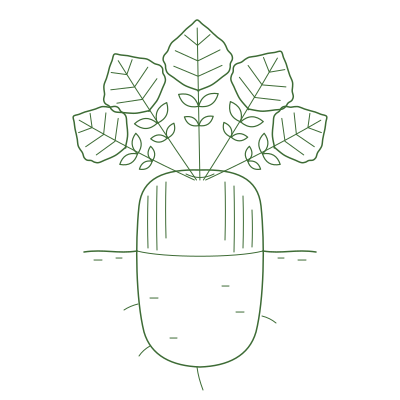
Korean Radish
Raphanus sativus var. longipinnatus
The stout, green-shouldered radish for kkakdugi — sown in late summer, pulled as the nights turn cold.
When to plant: sow about 10 weeks before your first fall frost.
Updated Oct 2026
At a glance
| Sun | Full sun |
|---|---|
| Water | Moderate |
| Spacing | 6 inches |
| Days to maturity | 55–70 days |
| Soil pH | 5.8–6.8 |
| Soil | Loose, well-drained soil worked 10 to 12 inches deep and free of stones and clods. Even moisture matters more than rich soil; too much nitrogen gives big tops and small roots. |
| Hardiness zones (USDA) | 3–11 |
| Difficulty | Beginner |
| Family | Brassicaceae |
| Native range | East Asia (cultivated; Korean types were developed in Korea) |
Tip for beginners: Sow on the 10-week fall date, cover the row with row cover the same day, and thin to one plant every 4 to 6 inches within two weeks — those three steps prevent most problems
Main challenge: Timing — spring sowings often bolt, and late-summer sowings need daily water in hot soil and row cover against flea beetles and root maggots
When to plant
- Sow, 10 weeks before your first fall frost.
What can go wrong
- Bolting before the root sizes up. A flower stalk shoots up and the root stays and woody. Most common in spring sowings, when cold nights are followed by lengthening days. Grow mu as a fall cr, and use -resistant varieties for any spring trial.
- Pithy, spongy roots. The inside turns dry and spongy, with a hollow center. Caused by leaving roots too long in warm weather, drought stress, or long exposure to temperatures below about 30°F. Harvest at size and before a hard freeze.
- Cabbage maggot tunnels. Brown, winding tunnels in the root that often rot. Caused by larvae of the cabbage maggot fly, which lays eggs at the base of young plants. from the day of sowing is the most effective prevention.
- Flea beetle damage. Small round holes across the leaves, worst on seedlings in late summer. Heavy feeding slows growth and can kill young plants. Row cover prevents most damage.
- Forked, split, or stunted roots. Forking comes from stones, clods, or compacted soil; splitting from uneven watering, especially heavy rain after a dry spell; thin roots from crowding. Dig deeply, water evenly, and thin to 4 to 6 inches.
- Clubroot. Stunted, wilting plants with swollen, distorted roots. A long-lived soilborne disease of the cabbage family, worse in acidic, wet soil. Rotate all brassicas and do not follow napa cabbage or other brassicas in the same bed.
Growing guide
Korean radish, mu, sits between the small red radish and the long Japanese daikon. The roots are stout, often 6 to 8 inches long and 2 to 3 inches thick, white with green shoulders, denser and sweeter than most daikon. That firm flesh is what holds its crunch in kkakdugi and in the radish strips layered into kimchi. Like napa cabbage, mu is mainly a fall crop in the US. Sown in spring, it tends to meet lengthening days after cold nights and bolts before the root fills. Sown in late summer, it sizes up as the weather cools, which is also when the flavor turns sweet.
Sow directly about 10 weeks before your first fall frost. The taproot is the crop, so mu is not a candidate for . Loosen the soil 10 to 12 inches deep and pick out stones, since roots that hit an obstacle fork or twist. Korean types are shorter than daikon and cope better with heavier or rocky ground, but they still grow straighter in a raised or deeply dug bed. Sow seeds 1/2 inch deep, a few every 4 to 6 inches in rows about 18 inches apart. In hot late-summer soil, water daily until the seedlings are up.
Thinning is the step people put off. Within two weeks of emergence, cut extra seedlings at the soil line so one plant stands every 4 to 6 inches; crowded roots stay thin and woody. After that, mu asks for steady moisture, roughly an inch of water a week. A dry stretch followed by heavy rain can crack roots, and drought makes them hot and fibrous. Skip fresh manure and high-nitrogen fertilizer before sowing; they push lush tops at the expense of the root.
Late-summer seedlings face flea beetles, which pepper the leaves with small holes, and cabbage maggots, whose larvae tunnel into the root and leave brown, rotting trails. Row cover laid on the day of sowing keeps out both. Mu is in the cabbage family and can be infected by clubroot, so rotate it with napa cabbage and other brassicas rather than following them in the same bed. Bolt-resistant Korean varieties such as Summit and Alpine are sold for spring sowing, and a spring crop is workable in some gardens, but a stretch of cold weather after sowing can still trigger a seed stalk. Treat spring planting as a trial and fall as the main crop.
Start pulling when the shoulders reach 2 to 3 inches across, usually 55 to 70 days after sowing. Loosen the soil with a fork before lifting, since a long root snaps easily. Mature roots handle light frost, but long periods below about 30°F can leave the inside pithy, so harvest before a hard freeze. Cut the tops 2 inches above the crown. The leaves, mucheong, can be blanched and dried as siraegi. Topped roots stored near 32°F at high humidity typically keep 6 to 10 weeks.
Harvest and keep
Expected yield
| Per plant | 1 root (1–3 lb) |
|---|---|
| Per square foot | 1.5–3 lb at 6-inch spacing in 18-inch rows |
| Peak harvest lasts | 3 weeks |
Roots hold in the ground for a few weeks in cool fall weather; harvest before a hard freeze.
Keeping the harvest
| Refrigerator | 2–8 weeks (tops removed, in a sealed bag) |
|---|---|
| Freeze | not recommended raw — texture collapses; fine for cooked soups if cubed and blanched |
| Can | vinegar-pickled radish can be water-bath canned with a tested recipe; kkakdugi and other kimchi are kept refrigerated, not canned |
| Dry | cut into strips and dry at 125°F (mu-mallaengi); greens can be blanched and dried as siraegi |
| Root cellar | topped roots in damp sand or perforated bags at 32–40°F — 2–3 months |
Twist or cut off tops right after harvest; leaves pull moisture from the root.
Varieties worth knowing (3)
- Alpine · 55 days. Korean radish with 5–8 inch by 2–2 1/2 inch roots, white with green shoulders. Described by Johnny's as the most common type grown for kimchi in Korea. Sweeter than long white Japanese types and better than long types in rocky soil. Bolt tolerance makes it a candidate for spring sowing.
- Summit · 55 days. Hybrid traditional Korean type, crisp and juicy with a mildly spicy flavor. Very similar to Alpine in size and appearance. Bolt resistant for spring plantings and a good choice for kimchi.
- Fall Storage · 60–65 days. Kitazawa's Korean hybrid for late-summer and early-fall sowing. Bred for keeping quality; the seller lists storage of up to four months after harvest.
Companions (4)
How to propagate (1)
Korean radish is grown from seed sown directly in the garden. The taproot is the harvest, so it is not transplanted.
From seed · easy · 90%+ success rate
When: Direct sow about 10 weeks before your first fall frost; spring sowing only with bolt-resistant varieties and as a trial
Sow seeds 1/2 inch deep, a few every 4–6 inches in rows about 18 inches apart. usually takes 4–7 days in warm soil; keep the surface moist until seedlings emerge. Thin to one plant every 4–6 inches within two weeks of emergence.
Regional notes (6)
Pacific Northwest
West of the Cascades, mild falls suit mu well and roots can size slowly into late fall. Wet soils encourage cabbage maggot and slugs; grow in raised beds and keep row cover on. East of the mountains, sow on time and water daily through late-summer heat.
Mountain West
Cool nights at elevation give sweet roots but a short season. Sow on time, use row cover to add a few degrees against early freezes, and water evenly, since dry air and wind can make roots fibrous and pungent.
Southwest
In the low desert, grow mu as a , sowing once daytime highs drop below about 90°F and harvesting through winter. Keep irrigation steady to prevent cracking. At higher elevations, follow mountain-west timing.
Midwest
Sow on schedule; the fall window is short and hard freezes come early in the northern Midwest. Heavy clay soils favor the shorter Korean types over long daikon. Water seedlings daily during late-summer heat.
Northeast
A dependable fall crop. Cabbage maggot is common, so row cover from sowing matters. Hard freezes can follow the quickly in northern areas; harvest before soil temperatures drop below about 30°F for long.
Southeast
Grown in fall and into winter. If the soil is still very hot on the sowing date, a sowing a week or two later can germinate better, and mature roots hold through light frosts. In mild coastal areas, roots can stay in the ground well into winter.
Saving seed
Saving seed
- Difficulty
- Hard. Needs isolation, hand-pollination, or a second year of growth. Reserve for gardeners who want to commit.
- Isolation distance
- 1500 ft. Without isolation or hand-pollination, it can cross with nearby varieties.
- Method
- Insect-pollinated and crosses with all other radishes, including spring radishes and daikon. Fall roots need winter cold to flower: overwinter them in the ground in mild areas, or store selected roots and replant them in spring.
- Timing
- Harvest pods when they turn tan and papery the following summer.
- Drying and storage
- Dry pods fully, crush or cut them open to free the seed, and store cool and dry in an envelope.
- Viable for
- 4 years (when kept dry and cool)
Alpine, Summit, and Fall Storage are hybrids and do not come true from saved seed.
Sources (3)
- Growing Daikon/Korean & Specialty Radishes, Johnny's Selected Seeds
- Radish, University of Illinois Extension
- Growing radishes in home gardens, University of Minnesota Extension
Related plants: Acorn Squash, Sweet Alyssum, Amaranth, Artichoke